How to Avoid Scams When Selling Feet Pics: 9 Red Flags
Scammers target new feet pic sellers. Learn the 9 most common scams, the red flags that give them away, and three rules that keep your money safe.
By Foot Love Editorial Team4 min read
In this article
Most people who buy feet pics are exactly who they say they are. A small number are not, and they go looking for new sellers who are keen to land a first sale. The good news is that almost every scam follows one of a handful of patterns. Learn them once and they become easy to spot.
Why new sellers are the main target
A scammer needs you to act before you think. New sellers are more likely to bend their own rules for a first sale, less sure what a normal buyer sounds like, and more willing to believe an offer that is too generous. None of that is a personal failing. It is just what scammers look for, and knowing it is most of the defence.
The 9 most common feet pic scams
1. The fake payment screenshot
The "buyer" sends a screenshot showing a payment that is "sent" or "pending" and asks for the photos straight away. Screenshots take seconds to fake. The only proof of payment is the balance inside your own account.
2. The overpayment refund
They claim to have paid too much by mistake and ask you to send back the difference. The original payment is fake, or is reversed a few days later, while the money you "refunded" was real and is gone.
3. The verification or unlock fee
You are told a large payment is waiting, but you must first pay a small fee to verify your account, release the funds, or upgrade. A genuine buyer never needs money from you. You never pay to get paid.
4. The gift card payment
The buyer offers to pay in gift card codes, or asks you to buy gift cards for them. Codes are often already used or invalid, and gift cards are very hard to trace or recover. Treat any mention of gift cards as a reason to end the conversation.
5. The push to move off the platform
They want to continue on a messaging app and pay through a payment app instead. Once you leave the marketplace you lose its seller protections, and many payment apps do not allow this kind of sale, so an account can be limited or closed with your money inside it.
6. The chargeback
The buyer pays, receives the content, then tells their bank or payment provider the charge was not authorised. The payment is pulled back and you have already delivered. This is the main reason off-platform payments are risky: there is nobody on your side of the dispute.
7. The big-spender promise
Someone offers a weekly allowance or a huge sum for very little, often within the first few messages. It leads to one of the scams above, or to a request for your bank login or other personal details. Real regulars are built over time, not announced in the first message.
8. The fake agent or promoter
A stranger offers to manage your profile, promote you, or send you buyers in exchange for an upfront fee or your login details. Never share your password with anyone, and be very sceptical of anyone who wants paying before they have done anything.
9. The fake support message
A message that looks like it comes from the platform says your account will be suspended unless you "verify" through a link. The link opens a copy of the login page that steals your password. Real support will not ask for your password. If you are unsure, ignore the link and log in by typing the site address yourself.
Red flags at a glance
Urgency. Pressure to send something right now, before you have had time to check.
Payment that is "pending". If it is not in your balance, it has not been paid.
Any request for money from you, whatever the reason given.
A push to leave the platform for another chat app or payment method.
Questions about your identity: real name, address, workplace, bank details, or ID.
Offers far above normal prices from someone you have never sold to.
Links you must click to "receive" or "confirm" a payment.
One flag on its own is a reason to slow down. Two or more is a reason to stop.
What to do if you have been targeted
Stop replying. You do not owe an explanation and arguing gets you nowhere.
Do not send content or money, even to "fix" the situation.
Take screenshots of the conversation, then report and block the account on the platform.
If you entered your password anywhere suspicious, change it straight away and turn on two-factor authentication if it is available.
If money has left your bank account or card, contact your bank as soon as you can.
Being targeted does not mean you did something wrong. It happens to almost every seller at some point, and the ones who report it make the platform safer for everyone else.
Protect your identity as well as your money
Scams are not the only risk. Keeping your face, your location, and your personal details out of your photos matters just as much. Our photo tips for beginners end with a privacy checklist worth running before every upload, and the safety section of our selling guide covers staying anonymous in more detail.
The bottom line
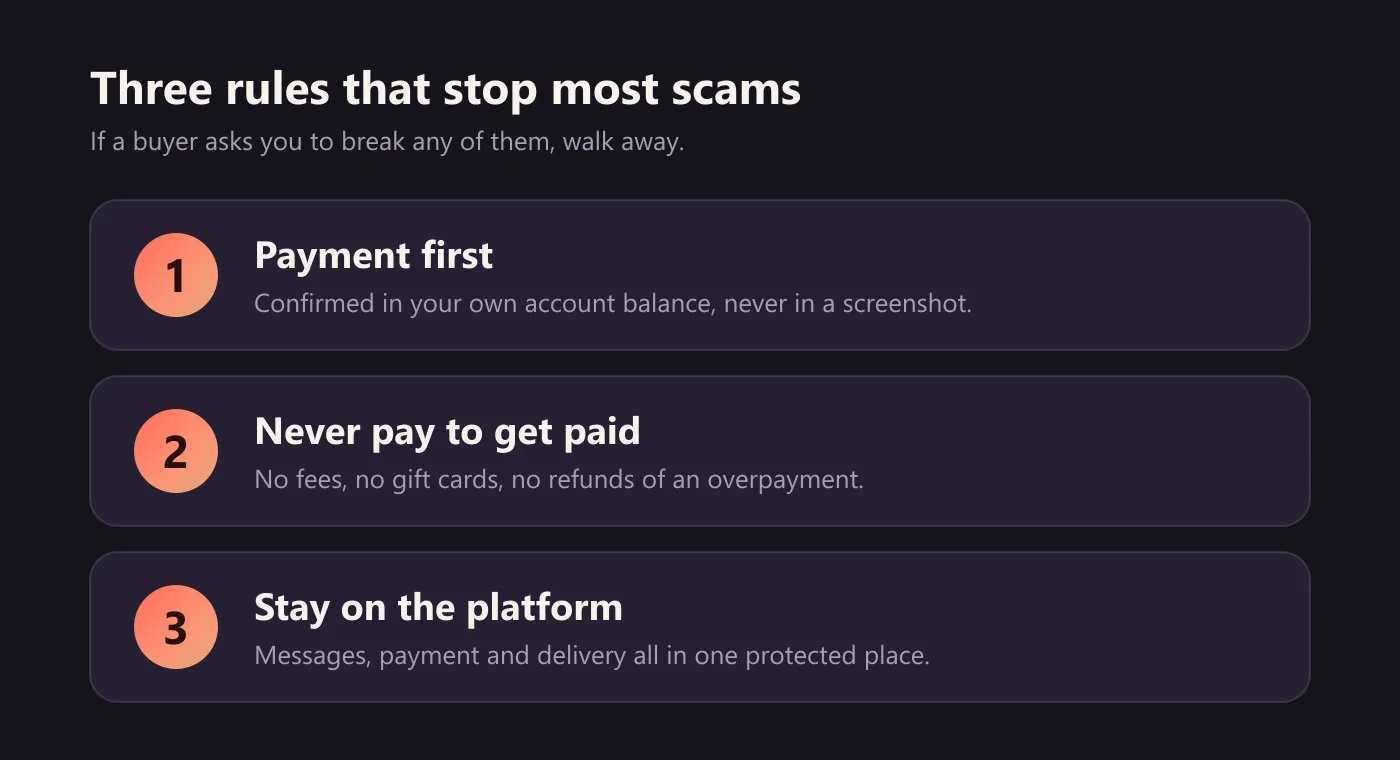
You do not need to be suspicious of everyone. You need three habits: confirm payment in your own balance before you send anything, never pay to get paid, and keep every message and payment on the platform. Sellers who stick to those lose very little to scams.
Looking for a marketplace built around those rules? Start with a free seller profile
New to all this? Our step-by-step guide to selling feet pics covers setup, pricing, safety, and what a realistic first six months looks like.
- scams
- safety
- beginners
Last updated: